 Wishfilled
Techniques
The mental diet: how to watch your thoughts without fighting them
Updated November 4, 2026 · 5 min read
A mental diet means choosing, for a set number of days, not to dwell on thoughts that contradict what you want. You catch a negative or old-story thought, decline to keep thinking it, and switch to one that fits the life you're assuming. The idea comes from Emmet Fox's 1935 pamphlet The Seven Day Mental Diet, and law of assumption communities use it alongside Neville Goddard's teaching.
It sounds strict, and the original version is. Below: where the idea comes from, how to do the 7-day and 21-day versions, what counts as a slip, and how to do it without turning it into another way to feel bad about yourself.
Where does the mental diet come from?
The term comes from Emmet Fox (1886–1951), a New Thought teacher whose short pamphlet The Seven Day Mental Diet (1935) challenged readers to spend a full week without dwelling on a single negative thought.
It's often credited to Neville Goddard, but the phrase is Fox's. Neville taught something closely related: watch your inner conversations, because what you habitually assume, in the quiet running commentary of your mind, becomes your experience. (If that's new, start with the law of assumption, explained simply.) In today's manifestation communities, "mental diet" means applying Fox's discipline to Neville's idea: for a set period, you keep your inner talk in line with the wish fulfilled.
Dwelling vs having a thought
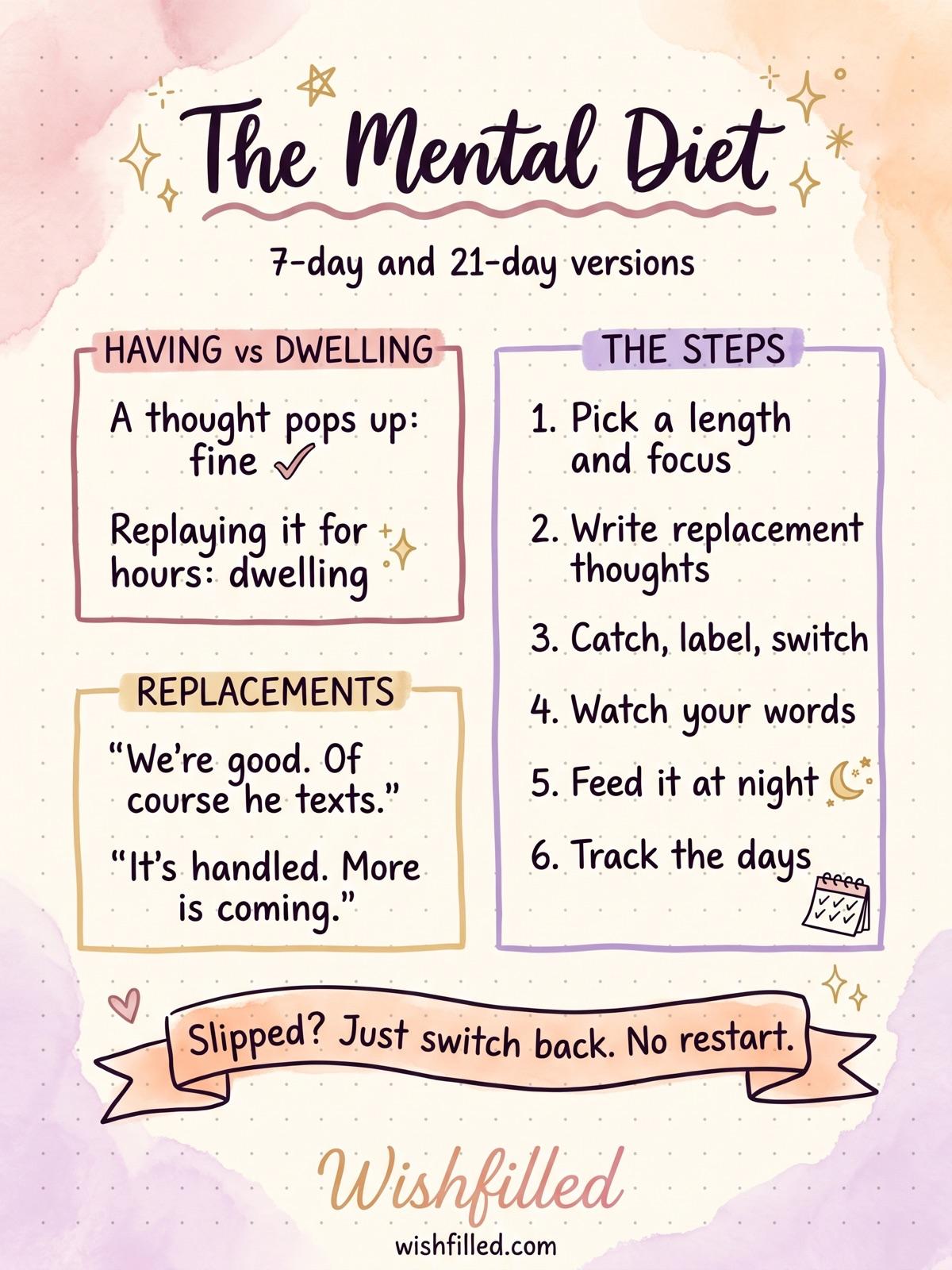
This is the distinction that makes the mental diet doable. Fox's rule isn't "never have a negative thought". Nobody can do that. It's "don't dwell on one".
- Having a thought: "What if he never texts?" pops up. That's fine. It's just a thought arriving.
- Dwelling on it: you replay the last conversation, check his profile, imagine the worst for twenty minutes. That's what the mental diet asks you to stop.
The skill is noticing the moment you start to dwell, and gently switching.
How to do the mental diet, step by step
1. Pick your length and your focus
Start with 7 days (Fox's original) or 21 days (popular in law of assumption communities). Pick one area to watch: your SP, money, your body, your work. You can widen it later.
2. Write your replacement thoughts in advance
You won't think clearly mid-spiral, so prepare two or three short lines that imply the end:
- SP: "We're good. Of course he texts."
- Money: "It's handled. More is coming."
- Self-concept: "I'm easy to love."
Our free affirmation generator can write a set for you. Self-concept work in particular helps here; see our self-concept affirmations.
3. Catch, label, switch
When you notice yourself dwelling:
- Catch: "I'm doing it again."
- Label: "That's the old story." No arguing, no analyzing.
- Switch: say one replacement line and turn your attention to something else: a task, a walk, a conversation.
The switch matters more than the line. You're redirecting attention, not winning a debate with yourself.
4. Watch your words, not just your thoughts
What you say out loud counts. "I'm so broke", "he always does this" and "nothing ever works for me" are the old story rehearsed in public. Change the subject, or say something neutral.
5. Feed it at night
End each day in the state you want to keep. Replay one short scene of the wish fulfilled in the drowsy state before sleep. Our SATS guide shows how.
6. Track the days
A simple tick on a calendar works. Seeing the streak grow makes it easier to catch yourself on day 5, when it gets hard.
What if you slip?
You will. Fox's original rule is strict: if you catch yourself dwelling on a negative thought, you start the seven days again. Some people find that motivating; many find it turns the practice into a test they keep failing.
A kinder version that most people stick with: a slip is only a slip if you keep going. If you catch it and switch within a minute or two, that's the practice working. If you spent an afternoon spiraling, note it, go back to your replacement line, and carry on, without starting over and without punishing yourself. The goal is a new habit, not a perfect record.
The mental diet and living in the end
The mental diet is the defensive side of living in the end. Living in the end is choosing to think from the wish fulfilled. The mental diet is noticing when you've slipped back into thinking from the old story, and stepping out of it. Together they cover the whole day.
A mental diet is not denial
You're not banning feelings. Sadness, anger and worry are real, and pushing them down usually makes them louder. Feel what you feel, and if something needs real attention (a bill, a health worry, a conversation you need to have), deal with it in the real world.
The mental diet is about the story you keep telling yourself afterwards, not about pretending everything is fine. If you notice it making you more anxious, or you're stuck in thoughts you can't switch away from, take a break, and consider talking to someone you trust or a professional.
Frequently asked questions
Did Neville Goddard create the mental diet?
The term comes from Emmet Fox's 1935 pamphlet The Seven Day Mental Diet. Neville taught a closely related idea, controlling your inner conversations, and law of assumption communities often combine the two.
How long should a mental diet last?
Fox's original is 7 days. Many people in manifestation communities do 21. Pick the length you can actually commit to; a 7-day diet you finish is worth more than a 30-day one you abandon on day 3.
Do I have to start over if I have a negative thought?
In Fox's strict version, dwelling on one means starting again. Many people find a kinder rule works better: catch it, switch, and keep going. The habit of switching is what you're building.
Is a mental diet the same as positive thinking?
Not quite. Positive thinking often means forcing happy thoughts. The mental diet is mostly about what you stop dwelling on, and replacing it with a calm, believable thought that fits the life you're assuming.
Keep reading
- SATS meditation script: guided scripts to read or record tonightFull SATS meditation scripts for love, money, career and self-concept: a relaxation lead-in, a looped end scene and a close. Read them or record them.
- How to write your own affirmations that actually feel trueA 6-step way to write your own affirmations: flip the old thought, keep it present tense and believable, add your details, then test and use them daily.
- Affirmations before sleep: 75 to say as you fall asleep75 positive affirmations to say before bed and sleep, by need, plus 15 positive thoughts for bedtime, kinder self-talk swaps and a 5-minute routine.