 Wishfilled
Law of Assumption basics
The law of assumption, explained simply
Updated October 27, 2026 · 6 min read
The law of assumption is the idea that what you assume to be true, and keep assuming, shapes what you experience. It comes from Neville Goddard, a mid-20th-century teacher. You practice it by imagining your wish as already fulfilled, feeling it as natural, and living from that feeling, instead of from the worry that it hasn't happened yet.
In simple terms: if you walk around assuming "he's losing interest" or "money is always tight", you act, notice and feel accordingly. The law of assumption asks you to change the assumption first and let your life follow.
This guide covers where the idea comes from, how it works according to its teachers, how to practice it, examples, and the questions people ask most, including whether it actually works.
Where does the law of assumption come from?
The law of assumption comes from Neville Goddard (1905–1972), a Barbados-born teacher who lectured in New York and Los Angeles from the 1930s to the 1970s. He usually signed his work simply "Neville".
His ideas are spread across his books and recorded lectures. The two most read today are short: Feeling Is the Secret (1944) and The Power of Awareness (1952). Neville drew heavily on the Bible, which he read as a psychological book about imagination rather than as history.
He didn't always call it "the law of assumption". The name became popular much later, mostly through YouTube, TikTok and communities like r/NevilleGoddard, where people share techniques and results. Many modern terms (SP, 3D, "robotic affirming", "the void") come from those communities, not from Neville himself.
How does the law of assumption work?
According to Neville's teaching, it rests on a few ideas:
- Imagination creates reality. What you imagine with feeling, and keep imagining, tends to show up in your life. Neville taught that imagination is the creative power, not a distraction from "real life".
- Feeling is what makes it stick. It's not enough to picture something. You have to feel what it would feel like if it were already true. His most repeated instruction is to assume the feeling of the wish fulfilled.
- Everyone is "you pushed out". Other people reflect your assumptions about them and about yourself. Change how you see someone, and, in this teaching, how they show up for you changes too.
- Persistence matters more than intensity. One powerful visualization doesn't do much if you spend the rest of the day assuming the opposite. What you assume most of the time is what counts.
- The 3D is the result, not the cause. The current physical situation (the "3D") is described as an echo of past assumptions. You don't take it as proof of anything. You change the assumption and let the 3D catch up.
A note on framing: these are the claims of a spiritual and self-development teaching, not scientifically tested facts. People practice it because they find it helps, in mindset, confidence and the way they act. Approach it as a practice, not as a guarantee.
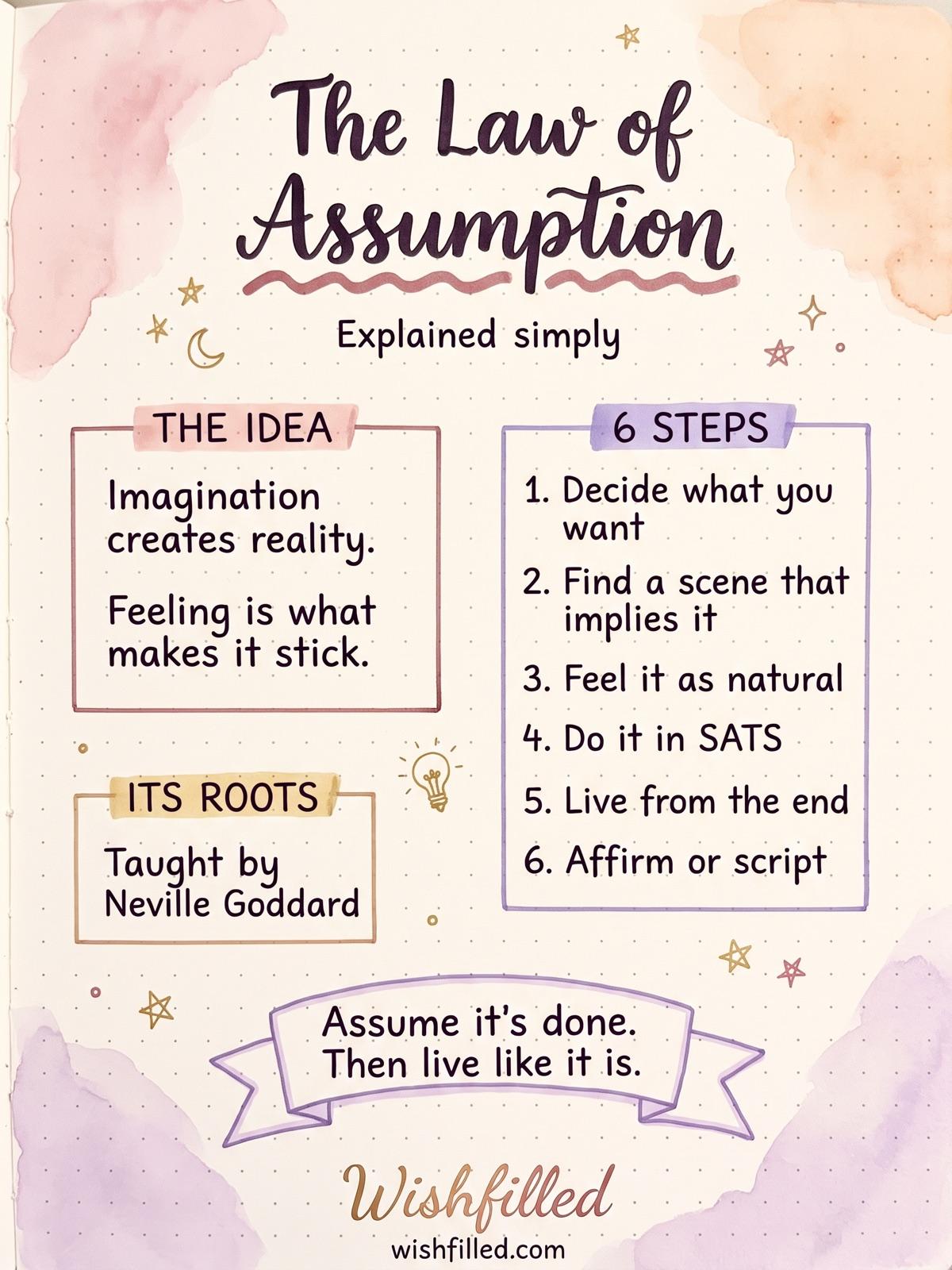
How to use the law of assumption, step by step
Here's a simple way to start, whatever you want.
1. Decide exactly what you want
Be specific. Not "more money" but "my first $10k month". Not "a relationship" but "a calm, committed relationship with someone who texts me first". Vague wishes are hard to feel. (Our guide on how to manifest a relationship walks through this for love.)
2. Find a scene that implies it's already done
Pick a short moment that could only happen after your wish came true. A friend congratulating you. A text with the words you want to read. Your banking app showing a balance of zero on the loan. Keep it to a few seconds, seen through your own eyes.
3. Feel it as natural
Replay the scene until it feels normal, almost boring, like a memory. The feeling to aim for is calm certainty ("of course"), not excitement or desperation.
4. Do it in the state akin to sleep
Neville recommended the drowsy state just before sleep, when your critical mind is quiet. Our SATS guide walks you through a 10-minute bedtime routine.
5. Live from the end during the day
This is where most people slip. Living from the end means acting like someone it already happened to. You stop checking for signs, you stop retelling the old story to friends, and you go on with your life. When doubt comes up, notice it and go back to the new assumption. Many teachers call this keeping a "mental diet". Our guide to living in the end shows what it looks like hour by hour.
6. Support it with affirmations or scripting
Short, present-tense affirmations help you hold the assumption during the day. Scripting means writing a journal entry as if the wish already came true. You can try both with our free affirmation generator and manifestation script generator.
Law of assumption examples
Here's how the same practice looks for different wishes.
A specific person (SP). Old assumption: "He's lost interest. He'll never text first." New assumption: "He thinks about me all the time." Scene: your phone lights up with his name and a message saying he misses you. During the day, you stop checking his socials. See how to manifest a text from a specific person, how to manifest your ex back and our list of affirmations for a specific person.
Money. Old assumption: "There's never enough." New assumption: "Money comes to me easily." Scene: you open your banking app and feel your whole body relax. During the day, you stop narrating every purchase as a loss. See our money affirmations that feel believable.
Career. Old assumption: "They'll pick someone more experienced." New assumption: "I'm the obvious choice." Scene: the offer email arrives, and you call your best friend. During the interview, you speak like someone who belongs there. More in how to manifest a job offer.
Self-concept. Old assumption: "I'm awkward in groups." New assumption: "People love being around me." Scene: a friend says, "You're glowing lately." During the day, you walk into rooms as that person.
In every example, the work is the same: change the inner assumption, feel the end, and persist in it, rather than trying to force the outer world.
Law of assumption vs law of attraction
The two often get mixed up, but they're framed differently:
| Law of assumption | Law of attraction | |
|---|---|---|
| Associated with | Neville Goddard | New Thought writers; popularized by The Secret (2006) |
| Core idea | What you assume and feel to be true is reflected back to you | Like attracts like: positive thoughts attract positive things |
| Focus | Your assumption and self-concept | Your thoughts and "vibration" |
| Typical practice | Imagining the end, SATS, living in the end | Positive thinking, vision boards, gratitude |
| Signs and "matching the vibe" | Not needed: you assume it's done | Often central |
Many people find the law of assumption simpler, because there's nothing to "attract": you assume the end and persist.
Frequently asked questions
What is the law of assumption in simple terms?
It's the idea that what you assume to be true about yourself, other people and your life shapes what you experience. You practice it by imagining your wish as already fulfilled, feeling it as natural, and acting from that feeling instead of from worry.
Does the law of assumption really work?
There's no scientific evidence that assumptions change outside events on their own. Many people say it works for them, and the practice does change things you control: your mood, your confidence, what you notice and how you act. Treat it as a mindset practice, keep taking practical steps toward your goals, and don't rely on it for medical, financial or legal decisions.
Is the law of assumption against religion?
Neville used the Bible throughout his teaching and saw it as a guide to imagination. Whether the practice fits your faith is a personal question, and people answer it differently. If it matters to you, talk it through with someone from your own tradition.
How long does the law of assumption take?
Neville didn't give a timeline. His teaching is that the change shows up once the new assumption feels natural, so the focus is on persisting until it does, not on counting days. Many people practice nightly for a few weeks.
Can I use the law of assumption on a specific person?
People do, and it's one of the most popular uses. In Neville's framework you only ever change your own assumptions: how you see the person and how you see yourself. It's never about pressuring, monitoring or controlling someone. If thinking about a person is causing you real distress, talk to someone you trust.
Keep reading
- Living in the end: what it means and how to do it every dayWhat "living in the end" means in Neville Goddard's law of assumption, how to think from the wish fulfilled, and what it looks like hour by hour.
- SATS: how to manifest in the state akin to sleepSATS, the state akin to sleep: what it is, what it feels like, why Neville Goddard taught it, and a simple 10-minute bedtime routine to do it tonight.
- Morning affirmations: 80 to start your day, and a 3-minute routine80 morning affirmations for positive energy, confidence, women, work, love and money, plus a 3-minute routine and good morning lines to send someone.