 Wishfilled
Career
How to manifest a job offer, before and after the interview
Updated November 6, 2026 · 5 min read
To manifest a job with the law of assumption, assume you already have it: imagine the moment after you're hired, like reading "We're thrilled to offer you the role" or a friend congratulating you, and feel it as natural, especially as you fall asleep. Then apply, prepare and interview as someone who already belongs there. The assumption changes how you show up. The applications are how the offer arrives.
Below: the scene, job affirmations, what to do in the anxious days after an interview, and the practical side that makes it real.
How does the law of assumption work for a job?
In Neville Goddard's teaching, what you persistently assume about yourself shapes what you experience. (New to it? Read the law of assumption, explained simply.) When you're job hunting, the usual assumptions are "they'll pick someone more experienced", "I never get callbacks" and "I'm not good at interviews". You carry those into every application and every call.
Manifesting a job means switching to "I'm the obvious choice" and "my next role is already mine", and persisting in it. That shows up in practical ways: you apply more boldly, you interview with less fear, and rejection stings less because you don't take it as a verdict.
Step 1: Get specific about the job
Write down what you actually want: the role, the kind of team, the salary range, the location or remote setup, how you want to feel on a Monday morning. If there's a specific company or listing, name it. Specific wishes are easier to imagine and easier to act on.
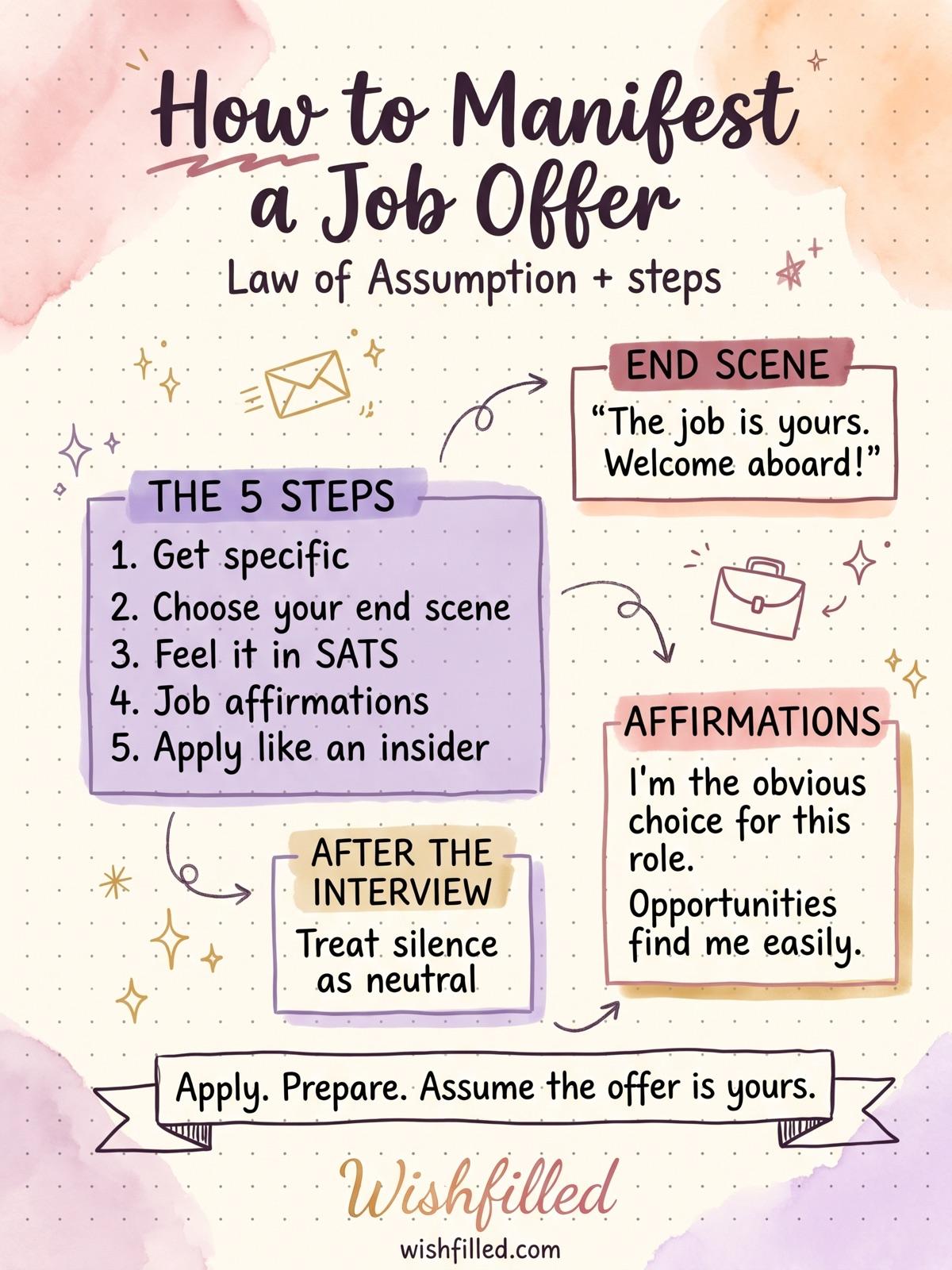
Step 2: Choose your end scene
Imagine a moment that could only happen after you're hired:
- An email arrives at 10:14: "We're thrilled to offer you the role." You read it three times.
- You sign the contract, and the salary is what you asked for.
- Your best friend hugs you: "Congratulations on the new job!"
- It's your first morning. You walk in, someone shows you your desk, and you think: I belong here.
Pick one. Keep it short and first-person, with a real detail: the time on the email, the café near the office, your friend's voice.
Step 3: Feel it in SATS
In the drowsy state just before sleep, the state Neville called the state akin to sleep (SATS), replay your scene until it feels like a memory. Aim for calm "of course", not giddy excitement. Our SATS guide has the routine.
Step 4: Use job affirmations
Choose three to five that feel believable:
- I'm the obvious choice for this role.
- Opportunities find me easily.
- I'm valued and well paid for what I do.
- I walk into every interview knowing I belong there.
- People love working with me.
- My next role is already mine.
- I'm confident in my skills, and it shows.
- Saying yes to the right offer is easy for me.
- Recruiters reach out to me.
- I'm so happy in my new job.
For more, including self-concept lines for confidence, see our self-concept affirmations.
Step 5: Apply and prepare like you already work there
This is where the assumption becomes visible. The person who's already been hired:
- Applies without apologizing. Tailor your CV and cover letter to the role, and send it. Don't talk yourself out of roles that feel like a stretch.
- Prepares like an insider. Research the company, the team and the problems they're solving, the way you would in your first week.
- Interviews as a colleague, not a candidate. Ask questions about the work, not just about whether they'll pick you.
- Follows up calmly. A short thank-you message within a day is normal, and it's what a confident professional does.
- Keeps going. They don't stop applying elsewhere while "waiting for a sign". People who already have options act from security.
How to manifest a job offer after the interview
The days after an interview are where most people drop the assumption: refreshing email, replaying every answer, imagining the rejection.
- Imagine the offer, not the outcome of your mistakes. When you catch yourself replaying an awkward answer, go back to your end scene.
- Treat silence as neutral. Hiring takes time: approvals, other candidates, holidays. A quiet inbox is not a no.
- Use one line when anxiety hits: "My offer is already on its way."
- Stay busy. Apply elsewhere, do something you enjoy. That's what someone with a job secured would do.
- Keep a mental diet. Notice when you start spiraling, label it, and switch.
What if you get rejected?
Rejections happen to everyone, including people who end up with great jobs. In law of assumption terms, a rejection is the 3D echoing an older assumption, or simply a role that wasn't yours. It isn't a verdict on you.
Note one thing you'd do differently, then go back to your scene. Many people find the job they end up loving was better than the one they were set on.
Frequently asked questions
Can you manifest a specific job?
Many people focus on a specific listing or company, and it can help to be concrete. In Neville's framework you change your own assumption, not the employer's decision, so stay open: assume "the right role for me is already mine" alongside the specific one, and keep applying.
How long does it take to manifest a job?
That depends on your field and the job market as much as on your mindset. What the practice changes quickly is how you feel and act during the search, which usually makes the search itself go better.
What should I do after an interview to manifest the job?
Send a short thank-you note, then return to your end scene each night and stop checking your inbox constantly. Keep applying elsewhere. Acting from security, rather than desperation, is the point.
Can I manifest a job without applying?
Stories of jobs "falling into someone's lap" usually leave out a lot. The law of assumption works on how you show up; applying, networking and preparing are how opportunities reach you. Do both.
Keep reading
- Morning affirmations: 80 to start your day, and a 3-minute routine80 morning affirmations for positive energy, confidence, women, work, love and money, plus a 3-minute routine and good morning lines to send someone.
- The best daily affirmations apps, matched to how you'll use themSeven daily affirmation apps compared by how you'll actually use them: reminders, widgets, your own voice, audio, glow-up plans or your specific wish.
- SATS meditation script: guided scripts to read or record tonightFull SATS meditation scripts for love, money, career and self-concept: a relaxation lead-in, a looped end scene and a close. Read them or record them.