 Wishfilled
Law of Assumption basics
Living in the end: what it means and how to do it every day
Updated November 3, 2026 · 5 min read
Living in the end means going about your day as the person whose wish is already fulfilled: thinking, feeling and making small choices from that state instead of from waiting. In Neville Goddard's law of assumption, it's how you persist in a new assumption between your imaginal acts, so the wish feels normal rather than far away.
Most people understand the idea in a second and struggle with it for weeks. This guide is about the struggle part: what it actually looks like at 8am, at lunch, when the phone stays quiet, and at night.
What does "living in the end" mean?
"The end" is the moment after your wish came true. You're together, the debt is paid, the offer is signed, you're the confident version of yourself. Living in the end means taking that state as your starting point for the day, rather than treating it as a destination you're anxiously traveling toward.
It comes from Neville Goddard's teaching that the feeling of the wish fulfilled is what shapes your experience. (If the wider idea is new, start with the law of assumption, explained simply.) One night of imagining does little if the next 16 hours are spent in "it hasn't happened yet". Living in the end is what fills those hours.
Thinking of the end vs thinking from the end
Neville drew a useful distinction between thinking of something and thinking from it.
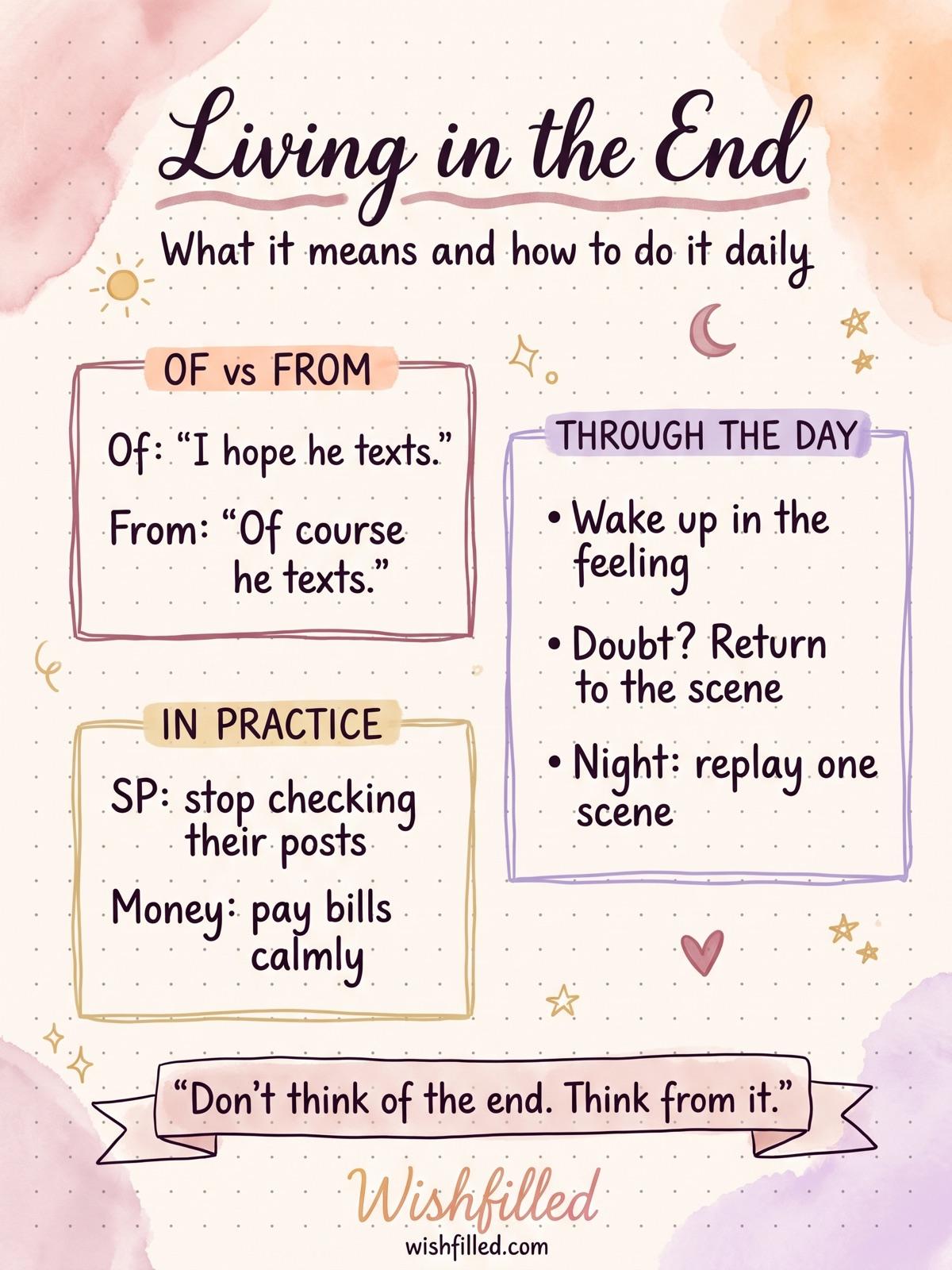
- Thinking of the end: "I really hope he texts. When he does, I'll feel so happy." The wish is out there, and you're looking at it from a distance.
- Thinking from the end: "Of course he texts, that's just how we are." You're looking at your day from inside the wish.
A quick test: if a thought contains "when", "hopefully" or "I need it to", you're probably thinking of the end. If it feels settled, ordinary and a little boring, you're thinking from it.
Signs you're not living in the end (and what to do instead)
| You notice yourself… | That's living in… | Living in the end instead |
|---|---|---|
| Checking their socials or online status | The waiting | Putting the phone down: you don't need proof of something that's done |
| Refreshing your banking app with dread | The lack | Opening it calmly, once, like someone who's fine |
| Asking for signs | The doubt | Treating today as one more ordinary day in the new reality |
| Retelling the old story to friends | The past | Talking about your life, or saying nothing at all |
| Panicking at a setback | The 3D as final | Calling it old information and going back to the end |
You'll slip constantly at first. Noticing the slip and returning is the practice.
How to live in the end, hour by hour
When you wake up
Before you check your phone, take ten seconds to wake up as the person it already happened to. What would they feel first thing? Relief, ease, a quiet "of course". Start the day from there.
During the day
Pick one or two small behaviors that match the end:
- SP: you'd stop checking whether they've posted, so you stop checking.
- Money: you'd pay a bill calmly, so you pay it calmly.
- Career: you'd speak in meetings like you belong there, so you do.
- Self-concept: you'd walk into the café like the version of you everyone notices, so you do.
You're not pretending to have things you don't. You're borrowing the state: the calm, the security, the self-respect.
When doubt shows up
It will. Don't fight it or analyze it. Notice it ("there's the old story"), then go back to one short line that implies the end (the core move of a mental diet), like "it's done" or "of course". Short affirmations are useful here because they're quick to reach for.
When the 3D contradicts you
A slow reply, a rejection, a bill you didn't expect. In law of assumption terms, the current situation reflects older assumptions, not where you're heading. Let it be information, not a verdict, and return to the end. (If a situation is genuinely unsafe or harmful, handle it in the real world first. Living in the end never means ignoring that.)
At night
This is where living in the end is easiest. In the drowsy state before sleep, replay one short scene from inside the fulfilled wish until it feels like a memory. Our SATS guide walks through it, and how to manifest while sleeping covers the full night routine.
Living in the end: examples
A specific person. You wake up and don't reach for your phone. At lunch, a friend asks about him, and you say, "We're good," and change the subject. At night you replay him pulling you closer on a Sunday morning. For the full approach, see how to manifest a specific person.
Being debt-free. You open your statement without bracing. You make this month's payment and think, "one closer to free." You notice the urge to complain about money and don't. At night: the "$0.00, paid in full" screen. More in how to manifest being debt-free.
A new job. You prepare for the interview like someone who already works there and wants to do well, not like someone begging to be picked. When the email doesn't come the same day, you shrug. (The full method: how to manifest a job offer.)
Self-concept. You catch the thought "I'm too much" and answer it: "I'm easy to love." You wear the thing you were saving for when you're "that person". More in our self-concept affirmations and how to manifest a glow-up.
Is living in the end the same as "acting as if"?
They overlap, but the emphasis is different. "Acting as if" is mostly about behavior. Living in the end is mostly about the inner state, with behavior following naturally. You can act confident while panicking inside; living in the end is about the feeling underneath the action.
It's also not denial. You still pay your bills, go to work, look after your health and respect other people's choices. You just do those things from security instead of fear.
Frequently asked questions
How do I live in the end when I don't feel it?
Start smaller. Choose an end that's one step away and believable, like a text instead of a proposal, or "I'm becoming good with money" instead of "I'm rich". Feelings follow repetition. You don't need to feel it perfectly. You need to keep returning to it.
How long do I have to live in the end?
Neville taught to persist until the assumption feels natural, which some describe as "losing interest" because it already feels done. There's no fixed number of days.
What's the difference between living in the end and SATS?
SATS is a technique you do for a few minutes at night, in the drowsy state before sleep. Living in the end is how you carry that same state through the rest of the day. They work best together.
Is living in the end a form of delusion?
It shouldn't be. It's a mindset practice: choosing to feel secure and act from that, while still dealing with real life. If it starts to mean ignoring real problems, isolating yourself, or feeling worse, step back and talk to someone you trust.
Keep reading
- The law of assumption, explained simplyWhat the law of assumption is, where it comes from (Neville Goddard), how to practice it step by step, examples, and an honest answer on whether it works.
- SATS: how to manifest in the state akin to sleepSATS, the state akin to sleep: what it is, what it feels like, why Neville Goddard taught it, and a simple 10-minute bedtime routine to do it tonight.
- Morning affirmations: 80 to start your day, and a 3-minute routine80 morning affirmations for positive energy, confidence, women, work, love and money, plus a 3-minute routine and good morning lines to send someone.