 Wishfilled
Techniques
How to write your own affirmations that actually feel true
Updated November 11, 2026 · 8 min read
To write your own affirmation, take a thought that keeps pulling you down, write the opposite you'd like to be true, and phrase it in the present tense as if it already is: "I always get ghosted" becomes "People enjoy staying in touch with me". Keep it short, positive and believable to you today, then add one detail from your real life so it feels like yours.
Ready-made lists are a good start, but the affirmations that stick are usually the ones you wrote yourself, in your own words, about your own life. Below: a 6-step method, a fill-in-the-blank formula, before-and-after rewrites, templates for love, money, career and self-worth, and the different ways to use them once they're written.
Why write your own affirmations instead of using a list?
A list gives you someone else's sentences. Some will land, most will slide past, because they weren't written for your situation. When you write your own, three things change:
- The words are yours. You'd actually say "I'm good at my job and people know it", not "I am a magnet for professional abundance".
- They answer your real doubt. An affirmation works best as the reply to a specific thought you keep having. Only you know what that thought is.
- They can hold details. A name, a place, a number, a moment. In the law of assumption, teachers stress assuming a specific state as already true, and details are what make a sentence feel lived rather than recited. (New to the idea? Start with the law of assumption, explained simply.)
How to write your own affirmations in 6 steps
1. Catch the thought you want to replace
For two or three days, notice the sentences that run on repeat: "Nothing ever works out for me." "I'm always the one who cares more." "I'll never earn enough." Write them down word for word. These are your raw material. Each one becomes an affirmation.
2. Write the opposite you'd like to be true
Flip each thought into what you want to be true, not into the mirror-image denial. "I'm not going to be broke" still has "broke" in it. "Money comes to me steadily" points at what you want.
3. Put it in the present tense
Write it as if it's already so: "I am", "I have", "I feel", "it's normal for me". "I will be confident" keeps confidence in the future. "I'm becoming more confident every day" or "I speak up easily" puts it in the now. This is the core of living in the end: you think from the wish fulfilled, not of it.
4. Make it believable today
This is where most self-written affirmations fail. If you feel a sharp "that's a lie" when you read it, your mind argues back every time. Soften it until it feels like a relief instead of a stretch:
- Too far: "I'm a millionaire."
- Closer: "I'm getting better with money every month."
- Too far: "Everyone loves me."
- Closer: "The right people like me as I am."
You can raise the bar as the softer version starts to feel normal.
5. Add one real detail
Swap something general for something only you would write. "I'm in a happy relationship" becomes "We cook dinner together on Sunday nights." "I love my job" becomes "I walk into the office on Monday and actually look forward to it." One detail is enough. More can make it clunky.
6. Read it out loud and trim
Say it once. If you stumble, it's too long or too formal. Cut words until it sounds like something you'd text a friend. Most good affirmations are between 4 and 12 words.
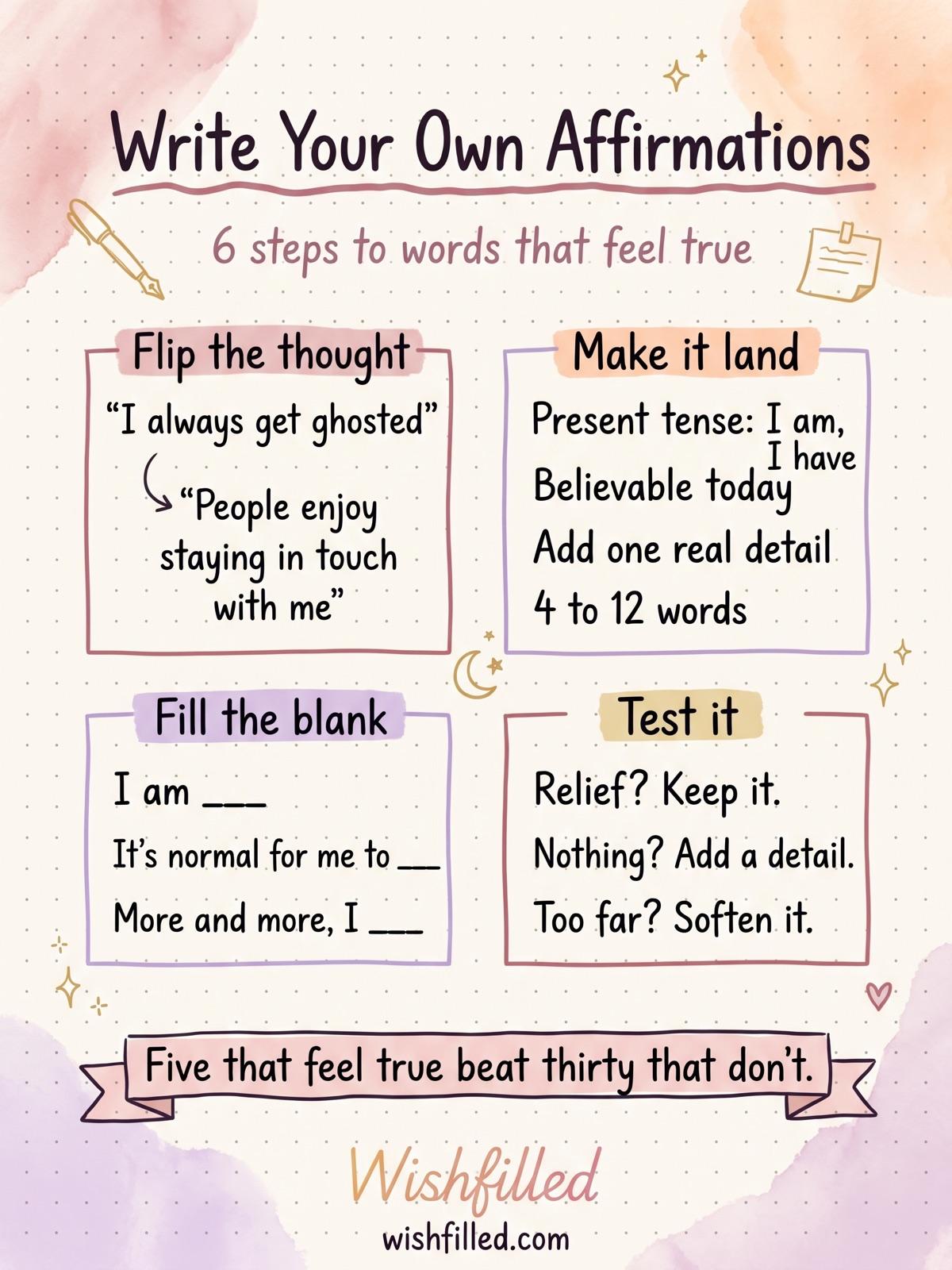
A simple formula for writing affirmations
If you're stuck on a blank page, use one of these frames and fill in the gap:
- I am _____. ("I am easy to love.")
- It's normal for me to _____. ("It's normal for me to be paid well.")
- I'm the kind of person who _____. ("I'm the kind of person who follows through.")
- I'm so grateful that _____. ("I'm so grateful that the move went smoothly.")
- I'm allowed to _____. ("I'm allowed to rest without earning it.")
- More and more, I _____. ("More and more, I trust myself.")
"It's normal for me" and "more and more" are useful when a flat "I am" feels like too big a jump.
Before and after: rewriting weak affirmations
| Weak version | Why it falls flat | Rewritten |
|---|---|---|
| I will find love one day. | Future tense, vague | I'm loved by someone who chooses me every day. |
| I'm not anxious anymore. | Names what you don't want | I feel calm and steady in my body. |
| I am rich. | Feels like a lie for many people | Money comes to me in steady, expected ways. |
| He will text me. | About controlling someone else | I'm someone people love to reach out to. |
| I am a confident, powerful, abundant goddess. | Too many words, not your voice | I walk into rooms like I belong there. |
| I hope I get the job. | A wish, not an assumption | I'm settling into my new role and it suits me. |
Notice the fourth row. An affirmation about another person's actions tends to make you watch for proof. One about how you see yourself keeps you calm, which is what our guide on affirmations for a specific person also recommends.
Templates for the most common goals
Copy the frame, then change the words until it sounds like you.
Love
- I'm loved, exactly as I am.
- My partner and I _____ (something you'd do together).
- Being treated well is normal for me.
Money
- I'm grateful for the $_____ that came in this month.
- Money comes to me through _____ (your real sources).
- I handle money calmly and well.
Career
- I'm good at _____ and people notice.
- I'm settling in at _____ (the role or company) and it fits me.
- My work is valued and paid fairly.
Self-worth and glow-up
- I like the person I'm becoming.
- I keep promises to myself, like _____.
- I'm enough before I change anything.
For more examples to adapt, see our self-concept affirmations and affirmations for love. If you'd like a starting draft to edit, our affirmation generator writes a set for the area you pick.
How to test whether an affirmation is right for you
Read it slowly and notice your first reaction:
- Relief or a small smile: keep it.
- Nothing at all: it's too generic. Add a detail.
- A sharp "no it isn't": it's too far. Soften it with "more and more" or "I'm learning to".
- Sadness or longing: it's written from lack. Rewrite it as if it's already handled, then read it again.
Five affirmations that pass this test do more than thirty that don't.
Ways to use your affirmations once they're written
Write them by hand. Many people in manifestation communities use repetition methods like writing one affirmation many times a day for a set number of days (you'll see versions like "55x5" or "21 days"). These are community practices, not rules. The useful part is the attention, so stop if it turns into a chore or a test you're failing.
Record them in your own voice. Use Voice Memos or any recorder, speak slowly, and listen as you fall asleep. That drowsy moment is what Neville Goddard called the state akin to sleep, when an idea is said to settle in with less resistance.
Put them where you'll see them. Your Lock Screen, a sticky note on the mirror, a card in your wallet, a Home Screen widget.
Turn one into a scene. An affirmation is a summary of a moment. Picture the moment itself: the message on your screen, a friend saying "I'm so happy for you", the email confirming the offer. Our scripting examples show how to write that scene out in full.
If writing them every day feels like a lot, Wishfilled does the writing for you: you type your wish, and the app writes daily affirmation cards and a narrated first-person story with your own names and places in them, and keeps today's affirmation on a Home Screen widget.
Common mistakes when writing your own affirmations
- Writing them about someone else. Keep the focus on you. Affirmations are never a reason to pressure, monitor or chase a real person.
- Using "not" and "never". "I'm not lonely" keeps lonely in the sentence.
- Making them huge on day one. Start believable, then raise the bar.
- Collecting too many. Pick three to five and live with them for a few weeks.
- Checking for proof every hour. That's assuming it hasn't happened yet. Say it, feel it, then get on with your day.
Affirmations are a mindset practice. They're not a replacement for medical, mental-health or financial advice. If your thoughts feel heavy or hard to shift on your own, talking to someone you trust or a professional is a strong move, not a failure.
Frequently asked questions
Can I make my own affirmations?
Yes, and for many people self-written affirmations feel more real than ready-made lists, because they use your words and answer your specific doubts. Start from a thought you want to replace, write the opposite in the present tense, and keep it believable.
Should affirmations start with "I am"?
They don't have to. "I am" is a strong opener because it's about identity, but "I have", "It's normal for me to", "I'm grateful that" and "More and more, I" all work. Pick the one that sounds natural to you.
How many affirmations should I write?
Three to five is plenty. A small set you repeat daily and actually feel beats a long list you skim. Swap one out when it starts to feel completely normal.
Is it better to write affirmations by hand or type them?
Either works. Writing by hand slows you down, which helps some people focus on the feeling. Typing makes it easy to set them as a Lock Screen or widget. Choose whatever you'll keep doing.
Can I create my own affirmations in an affirmation app?
Many affirmation apps let you add your own sentences, sometimes only on a paid plan, so check the app's listing or settings. Our comparison of manifestation apps covers which ones focus on your own words or voice.
Keep reading
- SATS meditation script: guided scripts to read or record tonightFull SATS meditation scripts for love, money, career and self-concept: a relaxation lead-in, a looped end scene and a close. Read them or record them.
- Affirmations before sleep: 75 to say as you fall asleep75 positive affirmations to say before bed and sleep, by need, plus 15 positive thoughts for bedtime, kinder self-talk swaps and a 5-minute routine.
- How to manifest while sleeping, and what really happens at nightCan you manifest while you sleep? What the law of assumption says, what sleep science says about overnight affirmations, and a night routine that works.